Using Chat
Chat is where you work with AI models directly. Chat with models like Claude and GPT, run your organization's prompts and tools, or work inside a Project.
The Chat Launcher
When you open Aisle, you land on the chat launcher. It's organized to help you quickly find what you need.
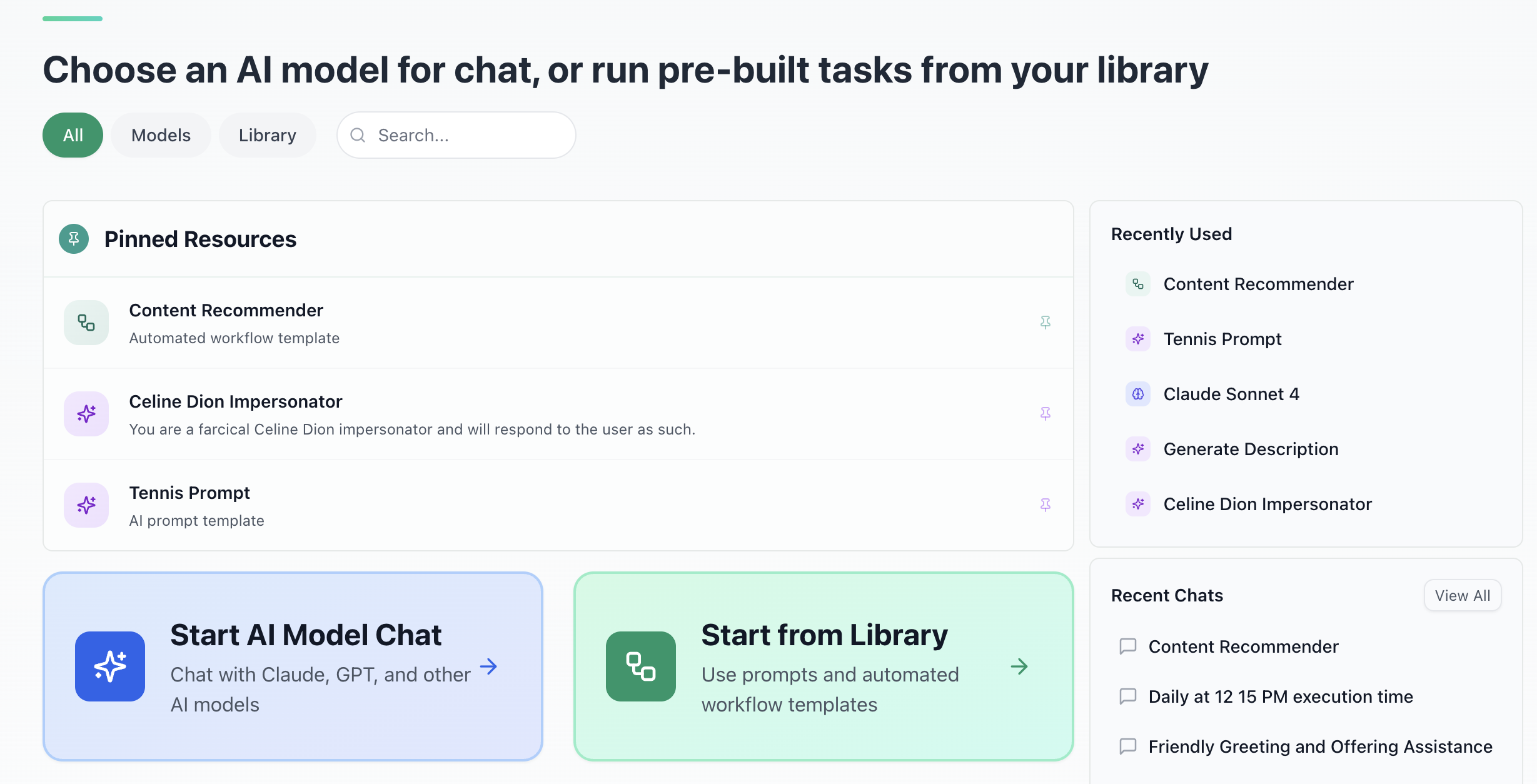
Start a chat
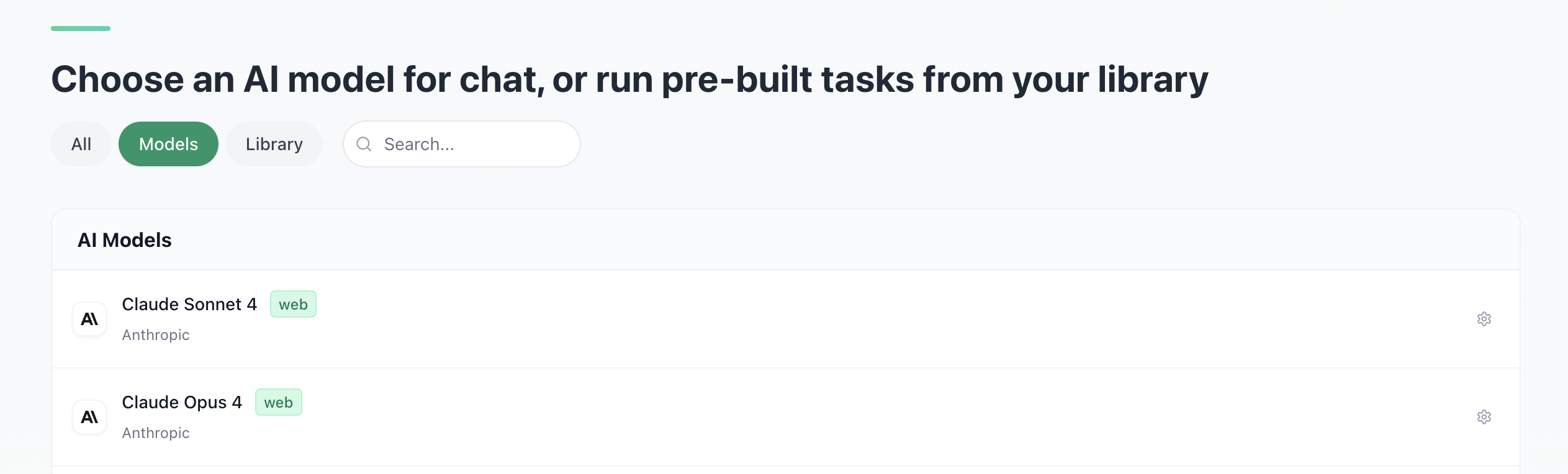
A grid of AI models from different providers — Claude from Anthropic, GPT from OpenAI, and others. Pick a model to begin a new direct chat.
Each model has different strengths:
- Some prioritize speed for quick responses
- Others excel at complex reasoning
- Some are better for creative tasks
- Others for structured analysis
Your organization controls which models are available. Admins can enable or disable specific models. See the full list of available models at app.aisle.sh/models.
Projects
Jump straight into a Project workspace. The launcher lists your Projects so you can open one and start a project chat — with its knowledge and connectors already attached — without going through the sidebar.
Library Tab
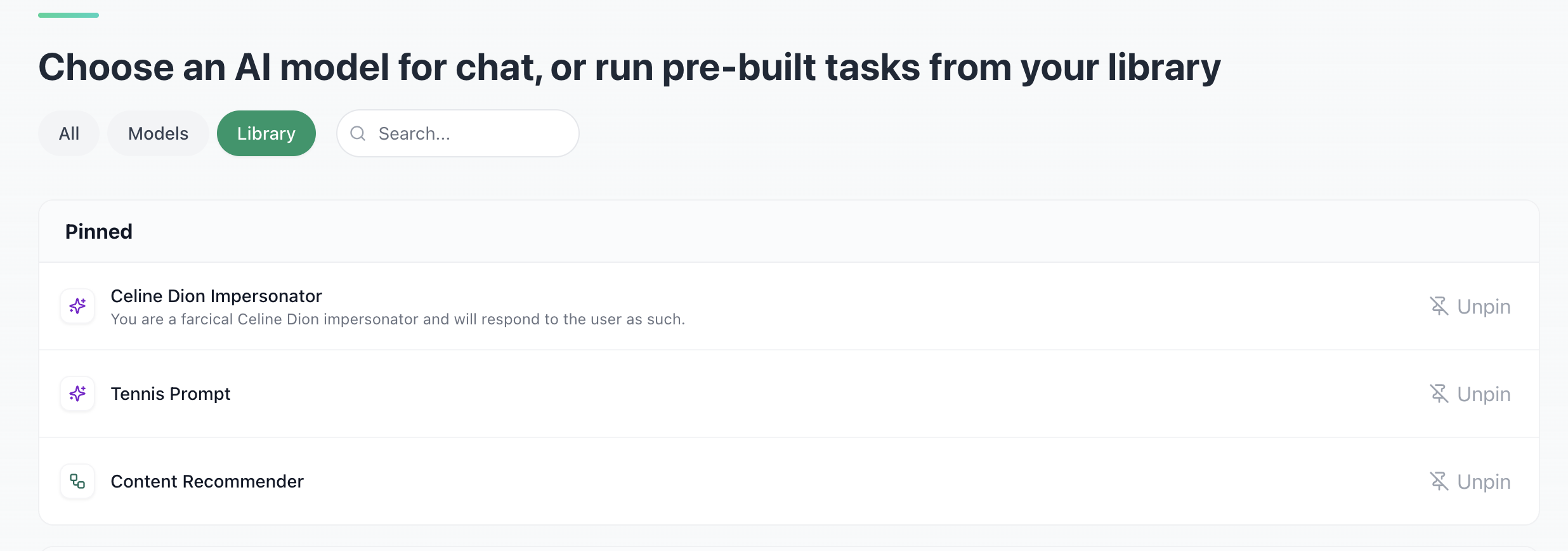
Your organization's custom prompts and runnable tools. These are specialized AI tools built for specific tasks.
Instead of a generic AI that does everything, library tools are configured for particular use cases:
- "Customer Feedback Analyzer" knows how to process feedback
- "Meeting Notes Summarizer" knows your meeting format
- "Brand Voice Reviewer" knows your style guide
Anyone on your team can run these tools without needing to craft the perfect prompt.
Pinned Items
Quick access to your most-used tools.
Admin pins appear first -set by your organization to highlight important tools everyone should use.
Your personal pins appear next - pin any library item by clicking the pin icon to keep it within reach.
Recents
Pick up where you left off. Your recent conversations and tool runs appear here for quick access.
Search
Find models, prompts, tasks, projects, and past messages by name. The box reads Search projects, tasks, prompts, messages… — type to filter the launcher instantly.
Models vs. Library
Use Models when:
- Exploring open-ended questions
- Iterating on ideas
- Having a conversation to figure something out
- Trying different approaches
Use Library when:
- Executing a known task
- Using a tool your team has built
- You want consistent, repeatable results
- The use case is well-defined
Models are general-purpose AI. Library tools are specialized for your organization's specific needs.
Starting Conversations with Models
- Open the chat launcher's Start a chat grid
- Select a model (for example, a Claude or GPT model)
- Optionally configure settings
- Type your message and send
Optional Configuration
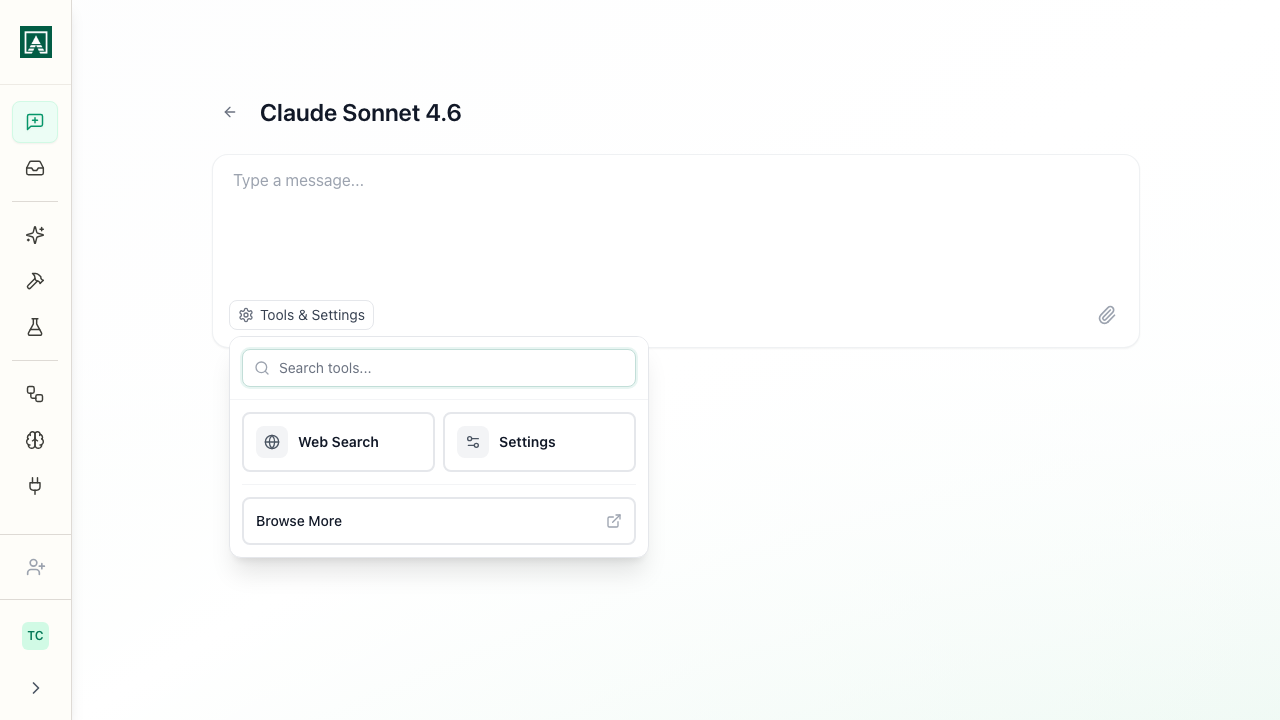
Before sending your first message, you can adjust tools and settings or attach files.
Tools & Settings - Click the Tools & Settings button in the input area to access:
| Tool / Setting | Description |
|---|---|
| Web Search | Lets the model search the internet for current information. Available on most models. |
| X Search | Lets the model search X (Twitter) posts via the xAI API. Available on supported models. |
| Search depth | For OpenAI models with web search: low, medium, or high. Higher depth retrieves more sources. |
| MCP Connectors | Select which of your connected MCP servers to enable for this conversation. Each enabled server gives the model access to its tools. |
| Temperature | Controls output variability. Lower values produce more consistent responses; higher values produce more varied ones. |
| Max Tokens | Maximum response length. |
| Thinking | On supported models (certain Claude and OpenAI models), enables an extended reasoning step before the final response. Useful for complex analysis. |
For most conversations, the defaults are fine. Adjust tools and settings when you have a specific need - enabling web search for current events, or enabling an MCP connector to query an external service.
Attach files - Upload documents (Word, PDF, PowerPoint, images, CSV, code files). The model can read, analyze, answer questions about the content, or compare multiple files.
Continuing the Conversation
Chat is conversational. The AI remembers context from earlier in the conversation. Ask follow-ups, clarify, iterate, change direction -it maintains the thread.
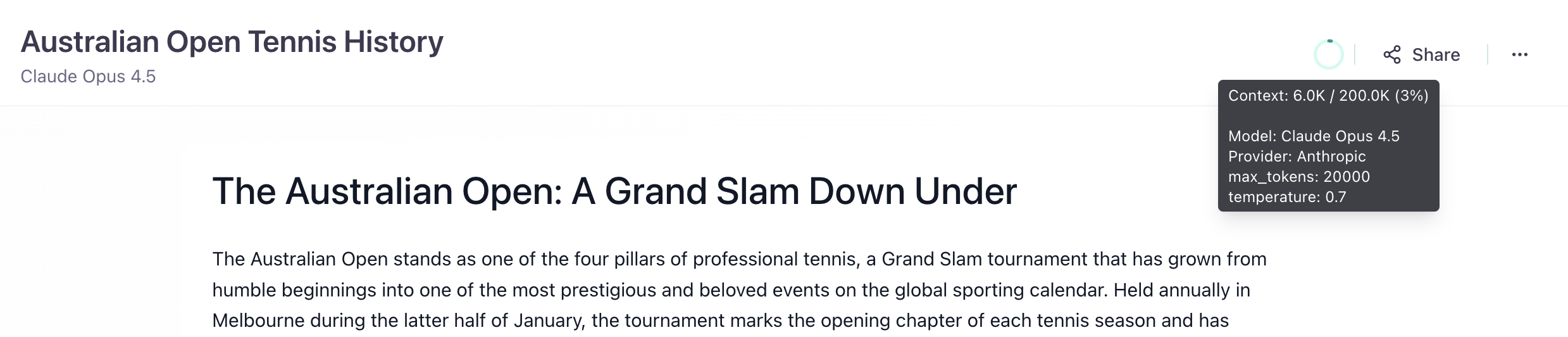
Context limits - The header displays your current token usage as a percentage of the model's maximum context window. Watch this to know when you're approaching limits. If you're running low, consider forking to a new conversation or switching to a model with a larger context window.
Managing conversations
Rename - Click the auto-generated title at the top of any conversation to rename it.
Delete - Open the conversation's action menu (the three-dot icon) and select Delete. Deletion is permanent.
Fork - Branch a conversation from any message point to explore a different direction without losing the original thread. See Forking a conversation.
Share - Share a conversation with teammates. See Sharing.
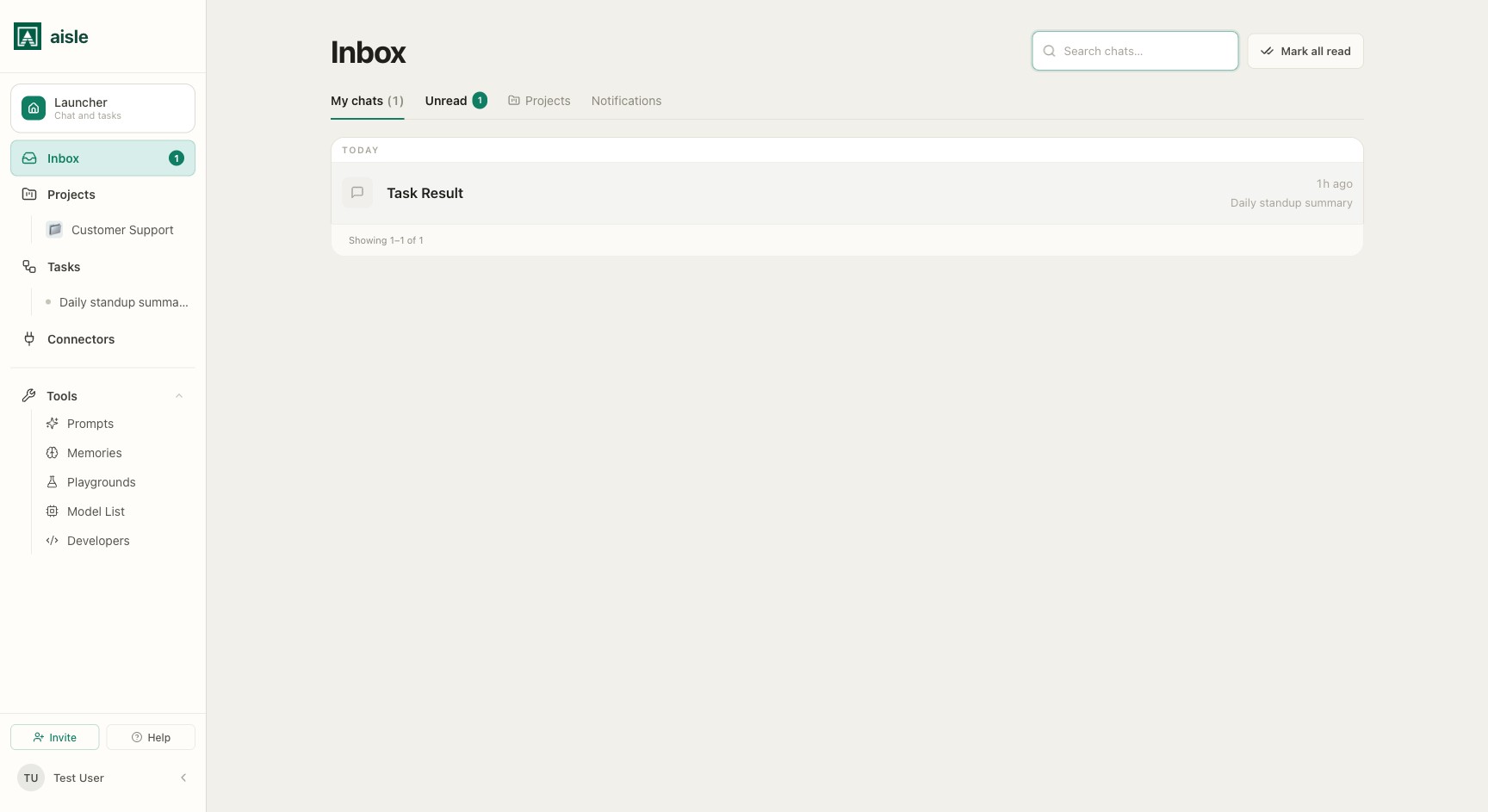
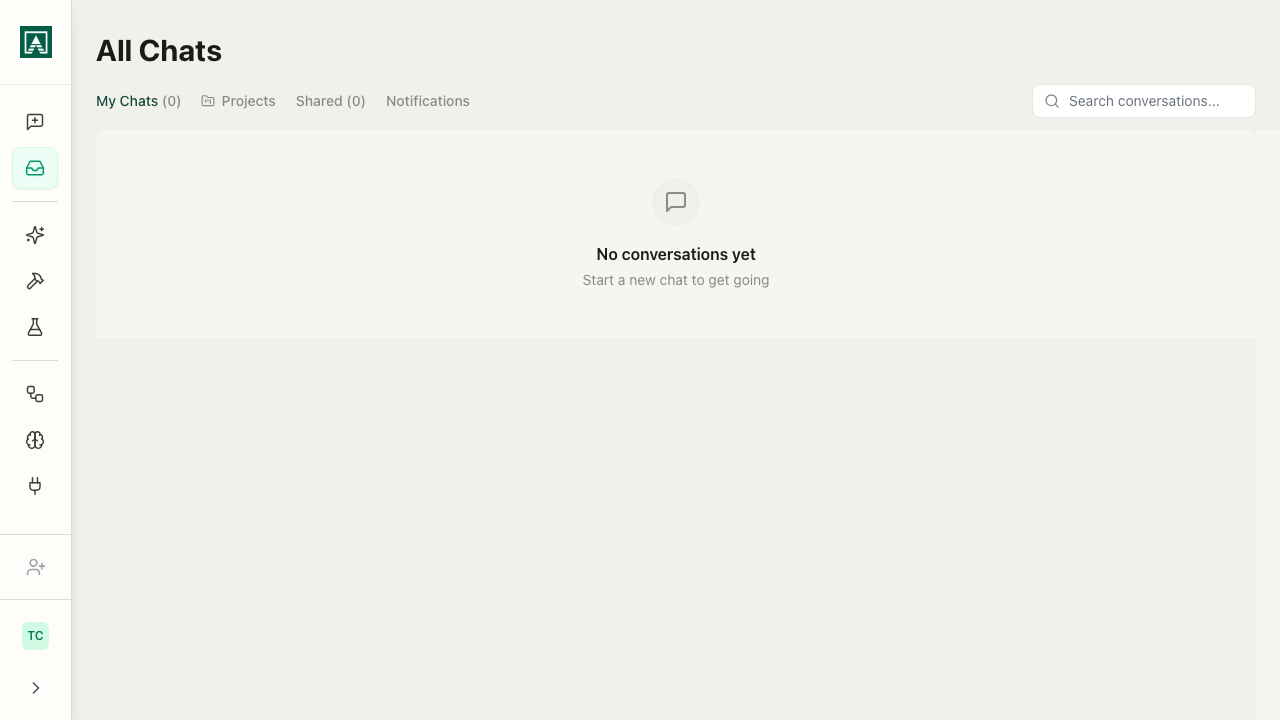
Search your history - Access all past conversations from Inbox in the sidebar.
Forking a conversation
Click the fork icon next to any AI response to branch the conversation. Aisle creates an independent copy containing every message up to that point — the full context intact — and opens it as a new chat. From then on the two conversations are completely independent: changes in one don't affect the other, and each keeps its own history. Forks are auto-named, so rename them to track what each one explores.
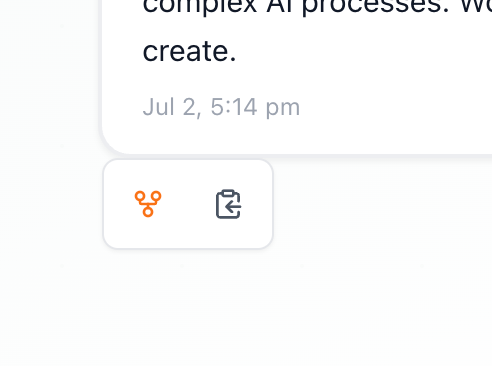
Fork when you want to keep the context you've built but try a different direction — exploring several strategic options in parallel, testing alternative fixes to the same bug, or spinning a tangent off your main thread without derailing it.
Inbox
Inbox organises your conversation history into tabs:
My chats - all conversations you have started, including direct model chats and library tool runs.
Unread - every conversation with unread activity for you, across all the other tabs. A badge shows the count, and Mark all read clears it.
Projects - conversations started inside a Project workspace. Filter by project using the project chips at the top of the tab. Chats also appear on the relevant Project home page.
Shared - conversations that other team members have shared with you. This tab appears once someone has shared a conversation with you. See Sharing for how sharing works.
Notifications - notifications about shared chats and system updates.
Search from the header to find conversations by keyword.
Running Library Tools
- Click the Library tab
- Select a custom prompt or runnable tool
- Fill in any required inputs
- Run it and continue the conversation
How Library Tools Work
Library tools are prompts and runnable Tasks your organization has built. They're pre-configured for specific tasks with built-in expertise.
When you run a library tool:
- It may ask for inputs upfront (customer feedback, article URL, etc.)
- It processes using its specialized configuration
- It returns results in the expected format
- You can ask follow-up questions or request revisions
Library tools are pre-configured for a specific task. Run them and get consistent output without writing the prompt yourself.
After Running
You can continue the conversation with the tool:
- Ask for clarification
- Request different formatting
- Dig deeper into specific parts
- Try variations
You can continue the conversation after running a library tool - ask follow-up questions, request changes, or dig deeper.